Ask Bhittai
A retrieval-augmented search engine over Shah Jo Risalo, the 18th-century Sindhi Sufi poetry of Shah Abdul Latif Bhittai.
- Year
- 2026
- Role
- Solo: data engineering, retrieval, evaluation, frontend
- Status
- Live
- Context
- Research build
Results
2,519
verse documents indexed
FAISS IndexFlatL2, 384-d multilingual embeddings
51
query benchmark
Hand-built retrieval evaluation set
27.45%
Recall@10
R@1 9.80% · R@5 23.53%: honest numbers on a hard corpus
Built on my own after an Advanced NLP course left me wanting to actually understand retrieval. The corpus came from AMBILE: 4,767 raw verses across all 30 Surs, cleaned by hand and by script (whitespace, missing data, language filtering) into a normalized JSON corpus of 4,730 entries. The 2,519 verses that carry an explanation are the ones indexed.
Roman Sindhi has no spelling rules, so the same word arrives five different ways. A preprocessing layer fixes that before retrieval: dictionary and regex normalization for common variants, and query expansion for characters and places, because embeddings don’t treat “Noori” as a proper noun. A query about Noori is expanded with Jam Tamachi and Keenjhar before it ever reaches the index.
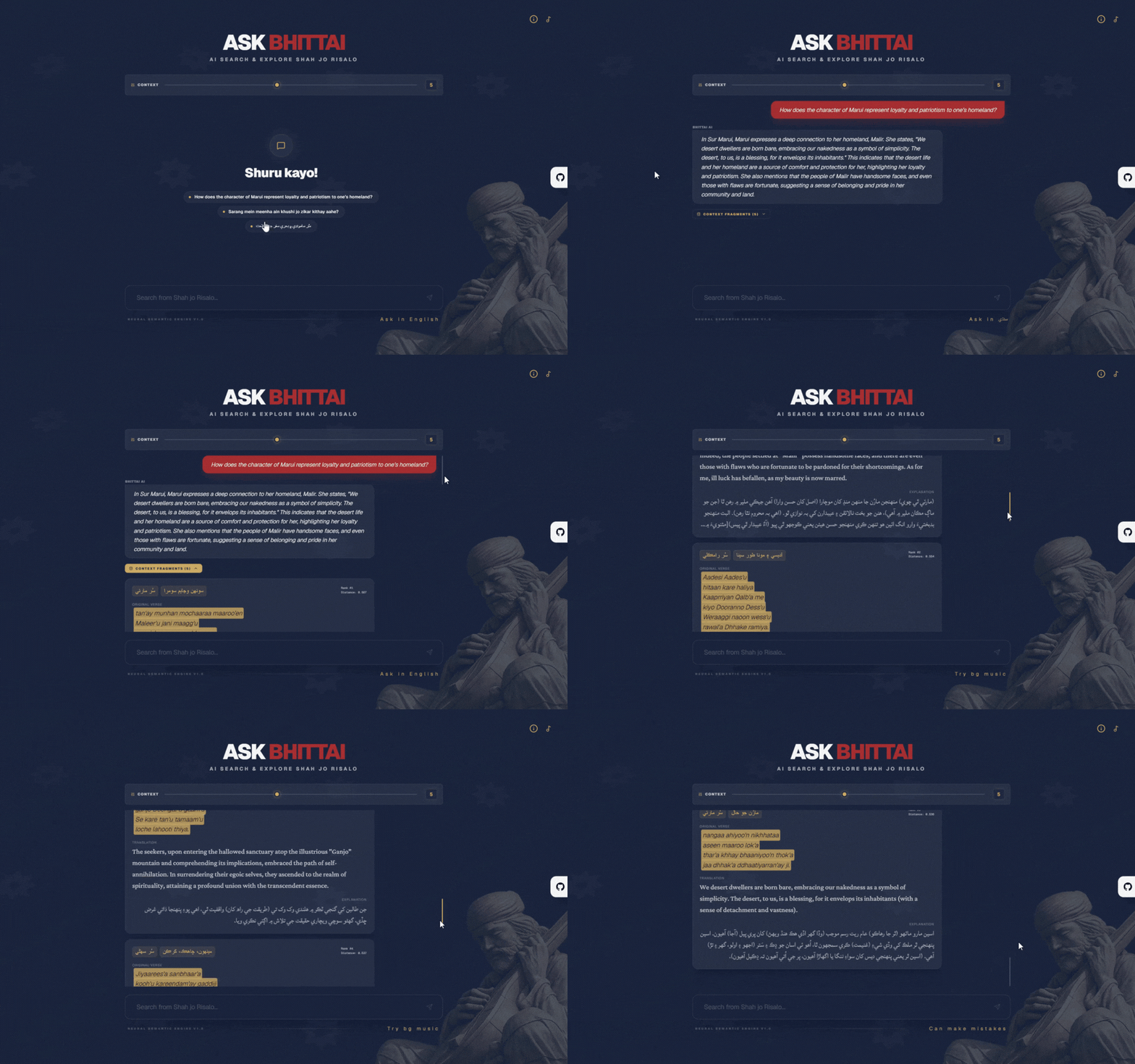
Verses are embedded with paraphrase-multilingual-MiniLM-L12-v2 (384 dimensions), so Sindhi and English queries share one vector space, and indexed in FAISS (IndexFlatL2, exact search). The retrieval helper returns structured context (the original verse, its translation, the explanation and the distance score) rather than a generated answer, and Gemini Flash answers on top of it with a custom system prompt. The Next.js frontend is deployed on Vercel.
I also built a 51-query retrieval benchmark and measured Recall@1, @5 and @10. The numbers are modest, and that is the point: they are measured, and they show exactly where the next improvement has to come from. Same RAG architecture, different chaos.
README · synced from GitHubOpen original ↗
Bhittai RAG is a small, practical RAG project for Shah Abdul Latif Bhittai's Risalo. It turns the raw dataset into a clean JSON format, builds a FAISS index over the verses, and lets you search for relevant context with Roman Sindhi queries.
What this project does
- Cleans and reshapes the raw CSV dataset.
- Exports a structured JSON file for retrieval.
- Creates a FAISS vector index for semantic search.
- Tests retrieval quality with a small benchmark.
Project Files
- dataset_formatter.ipynb prepares the dataset and writes
formatted_dataset/risalo.json. - RAG.ipynb loads the JSON, creates embeddings, builds
risalo_index.faiss, and runs retrieval examples. - formatted_dataset/risalo.json is the cleaned output used for search.
- risalo_index.faiss is the saved vector index.
- retrieval_benchmark.csv stores evaluation results.
How the pipeline works
1. Format the dataset
The formatter notebook reads base_dataset/risalo.csv, removes columns that are not needed, drops rows without Roman Script, and exports a smaller JSON structure.
Example record shape:
{
	"id": 1,
	"metadata": {
		"melody": "سُر ڪاموڏ",
		"chapter": "...",
		"type": "..."
	},
	"content": {
		"roman_text": "...",
		"explanation": "...",
		"english_translation": "..."
	},
	"searchable_text": "..."
}
2. Build the RAG index
The RAG notebook loads the formatted JSON, normalizes Roman Sindhi text, expands important query themes such as Noori, Marui, Sassui, Sohni, and Karbala, then embeds the text with a multilingual SentenceTransformer model.
3. Search the verses
The search_risalo() helper returns structured matches instead of a generated answer. That makes it useful for downstream apps, demos, and evaluation.
Examples
search_risalo("Keenjhar jo kinaro ain Noori")
search_risalo("Malir ain Marui ji galh")
search_risalo("Karbala ain Imam Hussain")
Each query returns:
- the original user query
- the processed query used for retrieval
- FAISS distances
- the top matching verses with melody, verse text, and explanation
Example workflow
import json

with open("formatted_dataset/risalo.json", "r", encoding="utf-8") as f:
		data = json.load(f)

context = search_risalo("Sacha ishq bare mein chah chayo aahe?")
print(json.dumps(context, indent=2, ensure_ascii=False))
Useful outputs
formatted_dataset/risalo.jsonfor clean structured datarisalo_index.faissfor fast similarity searchretrieval_benchmark.csvfor simple retrieval scoring
Evaluation & results
Based on a small benchmark of 50 queries covering key themes, the current retrieval setup achieves for each query the following accuracy scores (where "accuracy @K" means the correct verse was in the top K results):
- Accuracy @1: 9.80%
- Accuracy @3: 13.73%
- Accuracy @5: 23.53%
- Accuracy @10: 27.45%
These scores reflect the current retrieval setup. Important areas to improve accuracy are word preprocessing and handling misspellings in Roman Sindhi — both are actively flagged in the notebooks and are expected to raise accuracy when improved.
Short-term improvements to try:
- Expand the normalization map in
preprocess_roman_sindhito cover more variants. - Use fuzzy matching or edit-distance-aware embeddings for noisy Roman-script input.
- Increase synonym coverage in
expand_queryand add phrase-level expansions.
Notebook helpers & symbols
You can find two helpers used by the notebooks:
preprocess_roman_sindhi— normalization and simple spelling fixes for Roman Sindhi.Example inputs → outputs (demonstrates what the function actually does):
- "ishq" might be misspelled as "ishk" or "ishaq"
- "chayo" might be misspelled as "chayyo" or "chaayo"
- "ayen" might be misspelled as "ain" or "ayen"
- "muhnja" might be misspelled as "munja" or "muhnjaa"
expand_query— theme/synonym expansion to increase recall for named themes (Noori, Sassui, Marui, etc.).Example:
- Input:
"Noori" - Output:
"Noori Jam Tamachi Keenjhar Kamod Fisherwoman Lake Humility Lowly-born King-Jam-Tamachi Gandri | noori"(the notebook then lowercases/normalizes this string when you run the combined pipeline)
- Input:
Combined usage example (as used in the notebooks):
preprocess_roman_sindhi(expand_query("Noori"))→ a lowercased, punctuation-free, and normalized query string such as:"noori jam tamachi keenjhar kamod fisherwoman lake humility lowlyborn kingjamtamachi gandri noori"Note: the exact normalized output depends on the normalization-map rules; the key point is that
expand_queryincreases recall by adding related tokens, andpreprocess_roman_sindhicleans and normalizes them before embedding/search.
Query language & tips
Roman Sindhi (Latin script) is highly inconsistent and not easily parsed by standard tokenizers, spellings and transliteration vary a lot. To improve retrieval this project applies simple normalization and query-expansion, but the following guidelines help get the best results:
- Roman Sindhi (recommended): short keyword queries work well once normalized. Example:
Keenjhar jo kinaro ain Noori - English: use English keywords or short descriptions when easier. Example:
love and separation in Risalo - Sindhi (Arabic script): will also work as our explanation is in Arabic script.
Tips:
- Prefer short keywords or theme words (Noori, Sassui, Marui, Karbala).
- Combine languages if unsure (e.g.
Noori | Noori Jam Tamachi) to increase recall. - Use the
search_risalo()examples in the notebooks as copy-paste queries to reproduce results.
Notes
The notebooks are written to be lightweight and easy to inspect. You can run them from top to bottom to recreate the formatted dataset and the search index.
With <3 by Rehan Sathio for Sindhi Community!